Will Anderson Jr.'s $150M Deal Resets NFL Defensive Market
Will Anderson Jr.'s $150 million extension makes him the highest-paid non-QB in NFL history. How this historic contract reshapes the defensive market.
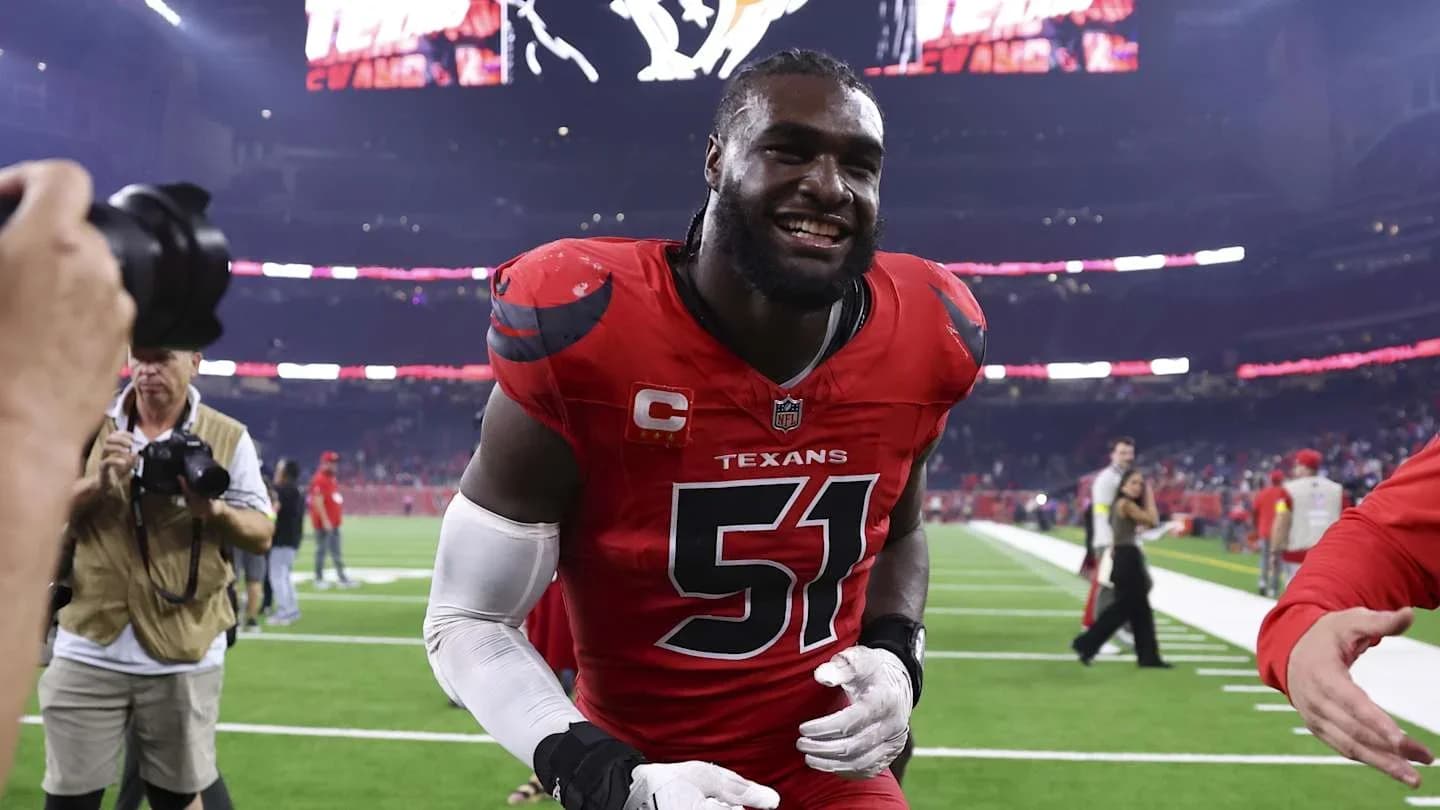
A New Ceiling for Defensive Players
Will Anderson Jr. just shattered the defensive player market. His three-year, $150 million extension with the Houston Texans averages $50 million annually—$5 million more than any edge rusher in NFL history. The previous record belonged to Aidan Hutchinson at $45 million per year with Detroit.
The gap Anderson created is staggering. Myles Garrett earns $40 million annually with Cleveland. Nick Bosa makes $34 million with San Francisco. Anderson's deal doesn't just reset the market—it establishes a new stratosphere for elite pass rushers.
Unprecedented Contract Structure
The guaranteed money tells the real story. Anderson secured $134 million guaranteed—89.3% of the total value. That percentage surpasses every defensive contract in league history. Hutchinson's deal guaranteed 78.3% of its value. Garrett's guaranteed 77.3%.
Houston also granted Anderson a no-trade clause, a privilege historically reserved for quarterbacks and legends like Aaron Donald. Only a handful of defensive players have ever received such protection. The clause gives Anderson complete control over his future, preventing the team from moving him without consent.
The structure reflects Houston's commitment beyond dollars. Teams typically spread cap hits across longer deals to maintain flexibility. This three-year window concentrates massive annual cap charges, signaling the franchise views Anderson as foundational to their championship window.
How Anderson's Deal Compares
The financial leap from previous benchmarks is dramatic. Anderson's $50 million average annual value represents an 11% increase over Hutchinson's $45 million. That's a bigger jump than the market saw between Bosa's $34 million deal in 2023 and Garrett's $40 million contract—a 17.6% increase spread over multiple years.
The guaranteed money gap widens further. Anderson's $134 million guaranteed exceeds Hutchinson's $141 million total contract value by $9 million in guarantees alone. Garrett received $123.6 million guaranteed. Bosa got $122.5 million. Anderson's security package dwarfs all predecessors.
This compression creates immediate pressure on teams with elite pass rushers approaching extensions. Every defensive star now has a new baseline. The market won't retreat from this ceiling.
Does Production Justify the Price?
Anderson's three-year track record shows consistent production. He recorded 11 sacks in 2023, 11.5 in 2024, and 12 in 2025. His 30 career sacks through three seasons demonstrate reliability. He generated 93 total pressures in his rookie year, including 70 hurries and 13 sacks according to Pro Football Focus.
Recent seasons show some decline in pressure generation. Anderson produced 59 pressures in 2025, ranking 22nd among edge rushers per PFF. That's down from 51 pressures in 2024, when he ranked 25th among 211 defensive ends. The sack totals remain strong, but advanced metrics suggest he's not yet an elite pressure artist.
Houston is betting on trajectory over current standing. Anderson turned 24 during the 2025 season. Peak years for edge rushers typically arrive between ages 25-29. The franchise is paying for what he'll become, not just what he's accomplished.
Cap Implications for Houston
The Texans entered 2025 with just $14.9 million in cap space against a $301.2 million salary cap. Anderson's extension will consume significant portions of future cap room. Houston projects approximately $196.8 million in effective cap space for 2026, but this deal will claim a substantial percentage.
Recent Super Bowl winners show varied approaches to defensive spending. Seattle's 2013 championship team invested heavily in defensive ends. New England's 2014 and 2016 titles came with focused spending on outside linebackers. No single formula guarantees success, but elite pass rush remains a common thread.
Houston's strategy aligns with championship-building models that prioritize quarterback and pass rush. With C.J. Stroud on a rookie contract through 2026, the franchise has a narrow window to build around affordable quarterback play. Anderson's extension maximizes that timeline.
Market Ripple Effects
Micah Parsons and Aidan Hutchinson already secured extensions in 2025, but Anderson's deal arrived after both. Parsons signed for $186-188 million over four years with Green Bay following a trade from Dallas. Hutchinson got $180 million over four years with Detroit. Both contracts now look like relative bargains.
The pass rusher market has exploded since 2020. Nick Bosa was the only edge rusher earning $30 million annually when 2024 began. By 2025, multiple players crossed $40 million. Anderson just established $50 million as the new benchmark. The escalation shows no signs of slowing.
Teams with elite edge rushers face immediate pressure. Any franchise negotiating with a top-tier pass rusher must now justify why their player deserves less than Anderson. The compression will force difficult decisions across the league.
A Philosophical Shift
Anderson's contract represents more than market inflation. It signals a fundamental reassessment of defensive value in an offense-dominated era. Houston is betting that elite pass rush can neutralize high-powered offenses built around $50 million quarterbacks. The logic is sound—pressure disrupts even the best signal-callers.
Whether this deal proves prescient or cautionary depends entirely on what comes next. Anderson must elevate his game to match the investment. Houston must win playoff games. The verdict won't arrive for years. But one thing is certain: the defensive market will never be the same.